RSS

How Calgary’s New Communities Are Changing the Market

Explore how Calgary’s newest master-planned communities are shaping the city’s housing trends with insights from 2% Realty Calgary.

Calgary is experiencing rapid urban expansion, driven by innovative master-planned communities that are redefining suburban living. High-demand neighbourhoods such as Seton, Livingston, and Alpine Park offer a dynamic mix of diverse housing options, top-rated schools, green spaces, retail hubs, and walkable amenities. These thoughtfully designed developments prioritize convenience, sustainability, and family-friendly planning, making them highly attractive to first-time homebuyers, move-up buyers, and growing families seeking long-term property value.

The surge of new construction in these communities is influencing Calgary’s overall real estate market trends. Increased competition among builders helps maintain housing affordability while elevating construction quality, architectural design, and modern features. Surrounding resale markets also benefit from heightened buyer demand, strengthening property values and boosting long-term appreciation potential in adjacent neighbourhoods.

At 2% Realty Calgary, our experienced real estate professionals closely monitor emerging community developments, pre-construction opportunities, and resale market performance. We guide clients through detailed comparisons between new builds and existing homes, helping them align their purchase with their lifestyle goals, investment strategy, and budget.

Calgary’s real estate growth story continues to evolve, and these forward-thinking master-planned communities are shaping the future of the city’s housing market, driving sustainable development, strong buyer demand, and modern community living.

Click here to get more information

Read

What’s Driving Calgary’s Real Estate Growth?

Population growth, jobs, and affordability — here’s why Calgary remains one of Canada’s most resilient housing markets.

Calgary’s real estate market continues to show strong housing growth, supported by steady population growth, stable employment rates, and relative affordability compared to other major Canadian cities. Families, professionals, and newcomers are attracted to Calgary for its quality schools, safe neighbourhoods, and diverse housing options that suit a wide range of budgets.

Economic stability remains a key driver of market strength. Expanding industries, job creation, and business investment continue to attract new residents, increasing both rental demand and homeownership activity. Major infrastructure projects, including new transit expansions and thoughtfully planned community developments, further enhance property values, connectivity, and overall livability.

At 2% Realty Calgary, we closely monitor these market trends and economic indicators to help our clients make strategic real estate decisions. Identifying high growth areas and understanding where future development is concentrated allows investors to target emerging communities with strong appreciation potential, while buyers can secure homes in neighbourhoods positioned for long term value.

Calgary’s housing market remains competitive because it successfully balances affordability, economic opportunity, and lifestyle appeal, making it one of Canada’s most attractive markets for both homeowners and real estate investors.

Read

Is Calgary’s condo market making a comeback?

2% Realty Calgary explores what buyers and investors should know this year.

In 2026, Calgary’s condo market is expected to remain balanced, creating favorable conditions for informed and strategic buyers. Ongoing affordability challenges in the detached home segment will likely keep condominiums in demand among first time buyers, downsizers, and real estate investors. With higher inventory levels available, competition may ease, giving buyers more negotiating power. Price growth is projected to stay moderate, with stability and gradual appreciation rather than rapid increases.

Urban condo communities, particularly in downtown, the Beltline, and transit oriented areas, are anticipated to perform more consistently. Demand from young professionals and renters seeking convenience, accessibility, and lifestyle amenities will continue to support these markets. At the same time, newer suburban condo developments may appeal to buyers searching for modern designs and competitive pricing. However, resale performance will still depend heavily on location, quality of building management, and reasonable condo fees.

Overall, 2026 is shaping up to be a year of steady and sustainable conditions for Calgary’s condo sector. Buyers and investors who focus on long term value, well managed buildings, and strong rental demand are likely to find great opportunities. Sellers may need to price strategically and highlight quality, upgrades, and location to stand out in a balanced and competitive real estate market.

Click here to get more information

Read

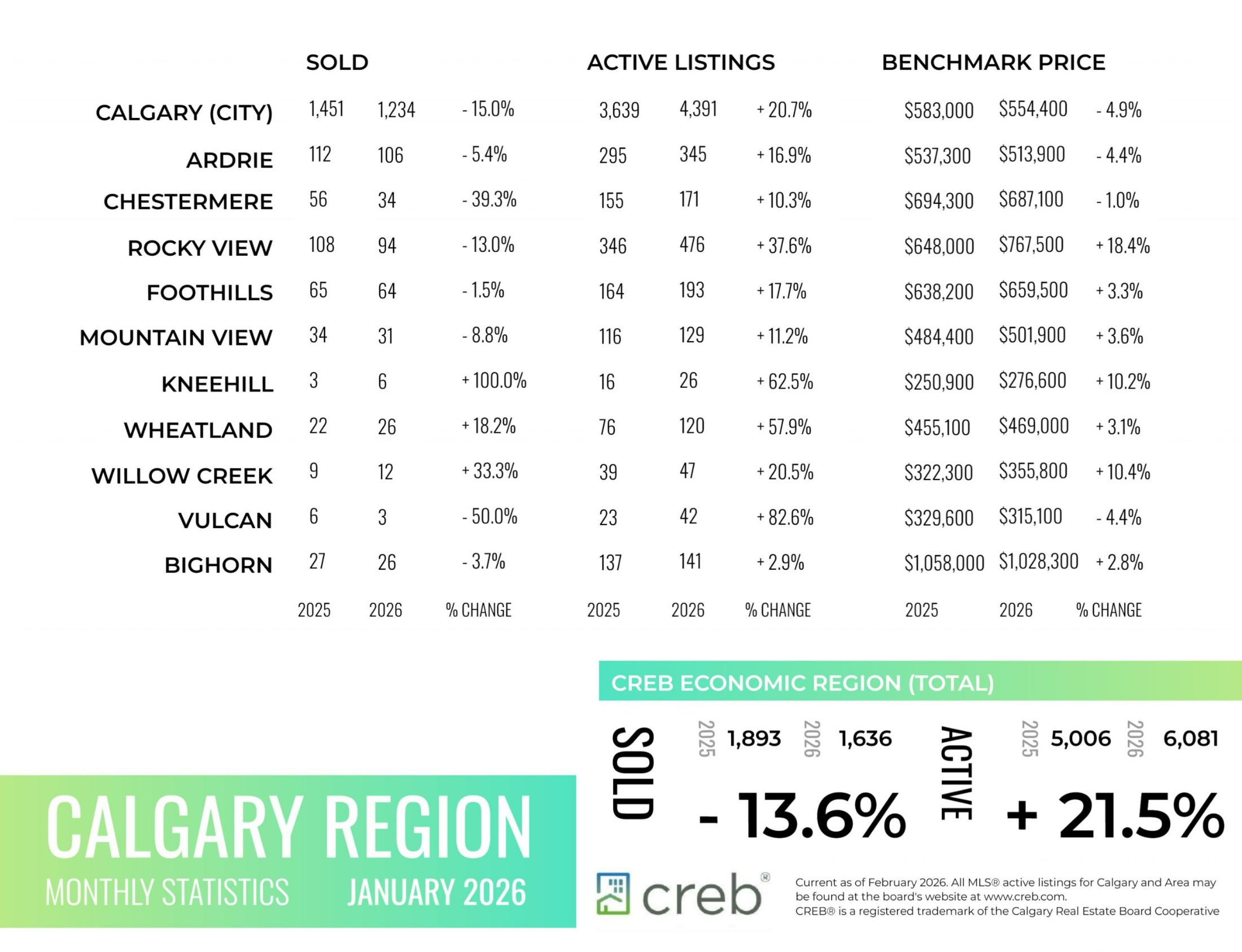
January 2026 CREB City And Region Market Reports

Slow start for high-density homes

Calgary reported 1,234 home sales in January, reflecting a 15% year-over-year decline, yet still aligning with typical activity levels for this time of year. While sales dropped across all property types, high-density homes, including apartments and row houses, saw the steepest decreases.

“Following the usual December slowdown, buyers of high-density homes were slower to return to the market in January,” said Ann-Marie Lurie, CREB®’s Chief Economist. “With more options available across the market, urgency among buyers has lessened. Meanwhile, sellers were quick to list their homes, driving the sales-to-new-listings ratio down to 44%, largely due to shifts in apartment and row-style properties. This trend is typical for January, as both buyers and sellers carefully consider their plans ahead of the spring market.”

The surge in new listings relative to sales pushed Calgary’s housing inventory to 4,391 units, the highest January level since 2020. Inventory levels differ by property type, with row and apartment homes seeing above-average supply. As a result, months of supply range from under three months for detached homes to five months for apartment-style properties, reflecting varying market conditions across property types.

Read the full report on the CREB website!

Custom real estate infographics published by myRealPage.com

Read
Data is supplied by Pillar 9™ MLS® System. Pillar 9™ is the owner of the copyright in its MLS®System. Data is deemed reliable but is not guaranteed accurate by Pillar 9™.
The trademarks MLS®, Multiple Listing Service® and the associated logos are owned by The Canadian Real Estate Association (CREA) and identify the quality of services provided by real estate professionals who are members of CREA. Used under license.